
Rosemary Essential Oil (Rosmarinus officinalis)
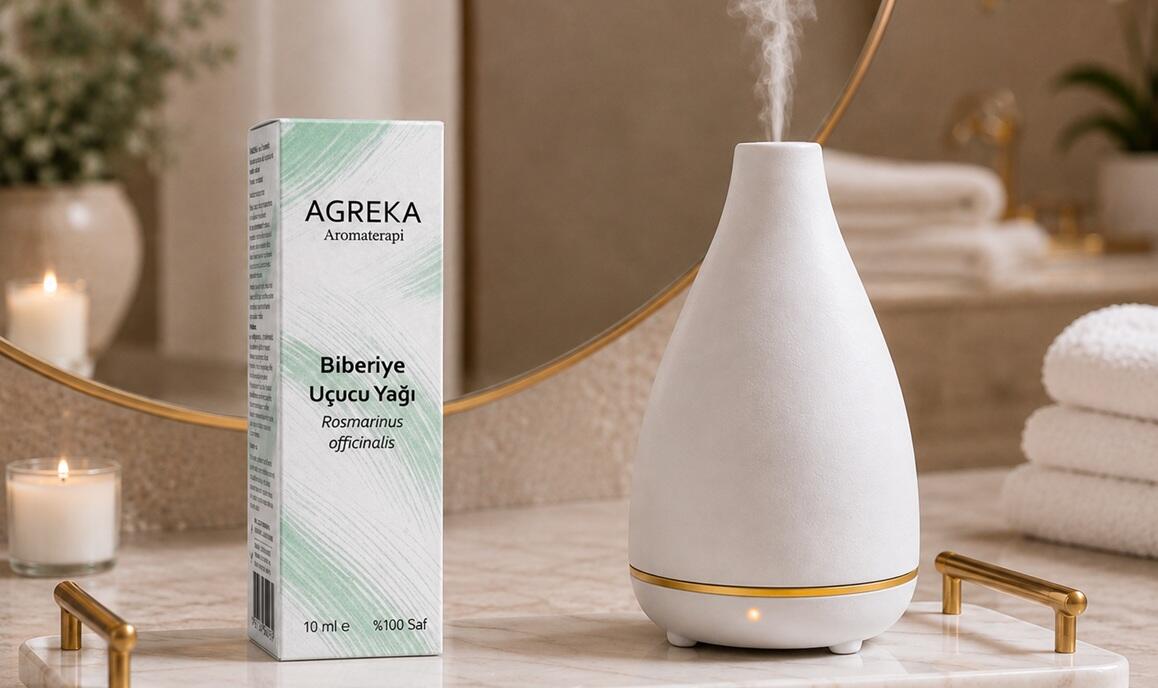
Chemotypes, Benefits, Uses, and Scientific Evidence
Rosemary essential oil is one of the best-known oils in aromatherapy for its mentally stimulating and revitalizing effects. However, the most important consideration with rosemary is that even when the oil comes from the same plant species, its effects may vary significantly depending on its chemotype.
The principal chemotypes commonly found in rosemary essential oil are profiles dominated by 1,8-cineole, camphor, and verbenone.
Rosemary Essential Oil – General Information
· Botanical (Latin) Name:Rosmarinus officinalis
· Plant Family: Lamiaceae (Mint Family)
· Origin: Spain, Croatia, South Africa (ct. camphor); Tunisia (ct. 1,8-cineole); France, Corsica, South Africa (ct. verbenone)
· Extraction Method: Steam distillation
· Plant Part Used: Flowering tops
· Color: Clear to pale yellow
· Aroma Profile: Fresh, strong, vibrant, and herbaceous
· Aromatic Note: Middle to top note
History and Traditional Use
The Latin name Rosmarinus means “dew of the sea.”
This name reflects the plant’s natural tendency to grow near coastal regions. Native to the Mediterranean Basin, rosemary grows naturally in Türkiye, particularly along the coastal regions of Western and Southern Anatolia.
Under suitable conditions, it can grow up to two metres tall. As an evergreen plant, it retains its leaves throughout winter and is also cultivated in gardens as an ornamental shrub and hedge. Its small flowers, which bloom between March and July, range from blue to violet.
Rosemary belongs to the Lamiaceae (Mint) family and has been widely used throughout history for both medicinal and aromatic purposes.
According to historical records, rosemary was regarded as sacred in Ancient Greek, Egyptian, Hebrew, and Roman civilizations. In Ancient Greece, students are said to have worn rosemary wreaths while reading and studying because the plant was believed to support memory and mental clarity.
In Greek and Roman cultures, rosemary was used during weddings, funerals, and festivals as a symbol of the cycle of life and death.
Rosemary leaves and rosemary oil have been used for centuries to flavour foods in Mediterranean cuisine. In Ancient Egypt, the plant and its extracts were also burned as incense.
During the Middle Ages in Europe, rosemary was believed to offer protection against the plague. Its branches were scattered across household floors and placed near doors and openings.
Its antimicrobial, anti-inflammatory, and antioxidant properties have supported its long-standing use in both traditional medicine and cosmetic applications. During the 16th century, despite the limited understanding of microbiology, rosemary was commonly used to purify the air in rooms occupied by sick individuals.
In folk medicine, rosemary has been valued for thousands of years for supporting memory, digestion, and relief from muscular discomfort.
Today, rosemary holds an important place not only in the culinary world because of its spicy and slightly medicinal aroma, but also in aromatherapy and natural wellness practices for supporting mental alertness, circulation, and muscle comfort.
Chemical Composition and Chemotype Differences: Why Are They Important?
The principal constituents frequently found in rosemary essential oil include:
· 1,8-Cineole
· Camphor
· Verbenone
· α-Pinene
· Borneol
Their concentrations may vary significantly depending on geography, harvest time, growing conditions, and chemotype.
For this reason, “rosemary essential oil” does not represent a single therapeutic profile. Selecting the appropriate chemotype is essential for achieving the intended benefit.
Benefits According to Rosemary Chemotype
Scientific evidence and traditional aromatherapy practice have been considered together.
1. Rosemary ct. Camphor
Respiratory Support
The monoterpene and camphor content of rosemary essential oil forms the basis of its use in aromatherapy approaches intended to support respiratory comfort and provide a decongestant effect.
Its use through steam inhalation has been evaluated as supportive care for upper respiratory congestion and flu-like conditions. [1]
Muscular Pain, Cramps, and Rheumatic Discomfort
The analgesic and muscle-relaxing properties of rosemary essential oil support its widespread inclusion in aromatherapy massage oils for:
· Muscle spasms
· Cramps
· Neuromuscular tension
· Rheumatic discomfort
Its antinociceptive effects have also been demonstrated in animal models. [1] [6] [7]
Circulatory Support
Rosemary essential oil is commonly used in massage applications because of its circulation-stimulating and warming properties.
This effect is considered supportive for promoting the sensation of peripheral circulation and relieving feelings of heaviness in the legs. [8] [9]
Digestive Support
Pharmacological reviews have described the carminative and antispasmodic properties of Rosmarinus officinalis.
These findings support the traditional use of rosemary essential oil in relation to digestive well-being but should not be interpreted as a clinical treatment claim. [10] [11]
Energy, Mental Stimulation, and Short-Term Memory
The stimulating aromatic profile of rosemary essential oil may provide support during:
· Mental fatigue
· Low energy
· Difficulty concentrating
Studies have reported findings linking exposure to rosemary aroma with cognitive performance. [3] [12] [14] [15]
2. Rosemary ct. 1,8-Cineole
Antibacterial and Antifungal Activity
In vitro studies have reported that rosemary essential oil demonstrates antimicrobial activity against various bacterial species, including Staphylococcus aureus, as well as certain fungal species.
This activity has been associated with its high concentration of 1,8-cineole. [5] [16] [17] [18] [19] [23]
Respiratory Support: Mucolytic and Decongestant Approach
Rosemary essential oil rich in 1,8-cineole is frequently used in aromatherapy applications associated with respiratory comfort.
It is evaluated through mechanisms that may help thin mucus and promote easier breathing. [1] [2] [20] [21] [22]
Muscle Stiffness, Fatigue, and Lactic Acid Accumulation
The circulation-supporting properties of rosemary essential oil and its effects on muscular tissue support its use in aromatherapy for post-exercise muscle fatigue and stiffness. [2] [6]
Mental Performance, Attention, and Memory
Human studies have shown a positive association between blood levels of 1,8-cineole following exposure to rosemary essential oil aroma and cognitive performance. [2] [3] [5] [12] [13] [14] [15]
Support for Age-Related Cognitive Function
Inhalation of rosemary essential oil has been associated with improvements in certain cognitive-function parameters in animal models of Alzheimer’s-type dementia. [2] [5] [15]
3. Rosemary ct. Verbenone
Antibacterial and Antifungal Activity
Rosemary essential oils with high verbenone content have been reported to demonstrate moderate antibacterial activity against various bacterial species.
Studies also indicate that the chemical profile of the oil, including the proportions of verbenone and α-pinene, may influence its antimicrobial activity.
Research has evaluated antimicrobial effects in oils where verbenone was either the principal constituent or present at relatively high concentrations. [23] [24]
Skin Regeneration and Wound-Healing Support
Animal studies have associated topical rosemary essential oil application with improvements in wound-healing parameters, including wound closure and tissue regeneration.
Research has also explored rosemary essential oil delivered through carrier systems, such as lipid nanoparticles, to support wound healing.
In aromatherapy, the verbenone chemotype is generally considered a gentler, more skin-focused rosemary profile. [25] [26]
Anti-Inflammatory and Pain-Sensation Support
Numerous reviews and preclinical studies have investigated the anti-inflammatory effects of rosemary essential oil. These effects are associated with the oil’s oxygenated monoterpene-rich chemical profile.
Studies have also evaluated verbenone as an individual compound for potential anti-inflammatory and antinociceptive effects. [27] [28] [29]
Antioxidant Protection and a Gentler Chemotype Profile
Rosemary essential oil ct. verbenone has a gentler and more balanced profile and is particularly preferred in products intended for skin contact.
Its antioxidant potential may help:
· Protect skin cells against free radical damage
· Support the prevention of premature skin aging
· Improve the skin’s resilience against environmental stressors
This activity is associated with the general antioxidant profile of rosemary essential oil. [30]
Safety Information
- Rosemary essential oil should not be applied to the skin without dilution.
- Chemotypes with a high camphor content may cause irritation or tolerance issues in sensitive individuals.
- It should not be used by individuals with a history of epilepsy or by children under six years of age.
- A more cautious approach is required for children over six years of age, and the dosage is particularly important.
- Individuals with hypertension or sensitivity to stimulating effects should use caution with inhalation or intensive use of rosemary essential oil.
- All chemotypes of rosemary essential oil should be avoided during pregnancy and breastfeeding.
- Individuals with chronic health conditions or those taking medication should consult a healthcare professional before use.
Scientific References
[1] Borges, R. S., et al. (2019). Rosmarinus officinalis Essential Oil: A Review of Its Phytochemistry, Anti-Inflammatory Activity, and Mechanisms of Action Involved. Journal of Ethnopharmacology.
[2] Moss, M., & Oliver, L. (2012). Plasma 1,8-Cineole Correlates with Cognitive Performance Following Exposure to Rosemary Essential Oil Aroma. Therapeutic Advances in Psychopharmacology.
[3] Sayorwan, W., et al. (2012). Effects of Inhaled Rosemary Oil on Subjective Feelings and Activities of the Nervous System. Scientifica.
[4] Jiang, Y., et al. (2011). Chemical Composition and Antimicrobial Activity of the Essential Oil of Rosemary. Food Chemistry.
[5] Satou, T., et al. (2018). The Effect of Inhalation of Essential Oil from Rosmarinus officinalis on Scopolamine-Induced Alzheimer’s-Type Dementia Model Mice. Flavour and Fragrance Journal.
[6] Rasković, A., Milanović, I., Pavlović, N., Milijašević, B., Ubavić, M., & Mikov, M. (2015). Analgesic Effects of Rosemary Essential Oil and Its Interactions with Codeine and Paracetamol in Mice. European Review for Medical and Pharmacological Sciences, 19, 165–172.
[7] de Faria, L. R. D., Lima, C. L., Perazzo, F. F., & Carvalho, J. C. T. (2011). Anti-Inflammatory and Antinociceptive Activities of the Essential Oil from Rosmarinus officinalis L. International Journal of Pharmaceutical Sciences Review and Research, 7(2), 1–8.
[8] Sagorchev, P., Lukanov, J., Beer, A.-M., & Sagorchev, S. (2010). Effects of Essential Oils on Smooth Muscle Tone and α-Adrenergic Receptors. Phytomedicine, 17(11), 785–789.
[9] Sayorwan, W., Siripornpanich, V., Piriyapunyaporn, T., Hongratanaworakit, T., Kotchabhakdi, N., & Ruangrungsi, N. (2012). The Effects of Rosemary Oil Inhalation on Emotional State, Autonomic Nervous System, and Brain Electrical Activity. Scientia Pharmaceutica, 80(2), 471–484.
[10] Naqvi, S. (2024). Dual Effectiveness of Rosemary Leaves in Constipation and Diarrhea. Research Square.
[11] Naqvi, S., et al. (2024). Unravelling the Multifaceted Role of Rosmarinus officinalis L. and Diosmetin in Managing Gut Motility. Journal of Ethnopharmacology. PMID: 38801915.
[12] Moss, M., Cook, J., Wesnes, K., & Duckett, P. (2003). Aromas of Rosemary and Lavender Essential Oils Differentially Affect Cognition and Mood in Healthy Adults. International Journal of Neuroscience, 113(1), 15–38.
[13] Moss, M., & Oliver, L. (2012). Plasma 1,8-Cineole Correlates with Cognitive Performance Following Exposure to Rosemary Essential Oil Aroma. Therapeutic Advances in Psychopharmacology, 2(3), 103–113.
[14] Pengelly, A., Snow, J., Mills, S. Y., Scholey, A., Wesnes, K., & Butler, L. R. (2012). Short-Term Study on the Effects of Rosemary on Cognitive Function in an Elderly Population. Journal of Medicinal Food.
[15] Filiptsova, O. V., Gazzavi-Rogozina, L. V., Timoshyna, I. A., Naboka, O. I., Dyomina, Y. V., & Ochkur, A. V. (2017). The Essential Oil of Rosemary and Its Effect on Human Short-Term Memory. Journal of Intercultural Ethnopharmacology.
[16] Jiang, Y., Wu, N., Fu, Y.-J., Wang, W., Luo, M., Zhao, C.-J., & Zu, Y.-G. (2011). Chemical Composition and Antimicrobial Activity of the Essential Oil of Rosemary. Food Control, 22(6), 801–806.
[17] Wang, W., Wu, N., Zu, Y.-G., & Fu, Y.-J. (2012). Antibacterial Activity and Anticancer Activity of Rosmarinus officinalis L. Essential Oil Compared with Its Main Components. Molecules, 17(3), 2704–2713.
[18] Ghavam, M., Afzali, A., & Manca, M. L. (2022). GC–MS Analysis and Antimicrobial Activities of Rosmarinus officinalis Essential Oil.
[19] Boukhobza, Z., et al. Essential Oil of Rosmarinus officinalis L., 1,8-Cineole Chemotype: In Vitro Antifungal Activity Against Fusarium oxysporum f. sp. albedinis.
[20] Sudhoff, H., et al. (2015). 1,8-Cineole Reduces Mucus Production in a Novel Human Ex Vivo Model of Rhinosinusitis. PLOS ONE, 10(7), e0133040.
[21] Kehrl, W., Sonnemann, U., & Dethlefsen, U. (2004). Therapy for Acute Nonpurulent Rhinosinusitis with Cineole: Results of a Double-Blind, Randomized, Placebo-Controlled Trial. The Laryngoscope, 114(4), 738–742.
[22] Fischer, J., Dethlefsen, U., & Ludwig, J. (2013). Efficacy of Cineole in Patients Suffering from Acute Bronchitis: A Placebo-Controlled Double-Blind Trial. Cough, 9, 25.
[23] Pieracci, Y., et al. (2021). Antimicrobial Activity and Composition of Five Rosmarinus officinalis L. Cultivar Essential Oils. Plants.
[24] Elyemni, M., et al. (2022). Chemical Composition and Antimicrobial Activity of Essential Oil of Wild and Cultivated Rosmarinus officinalis from Two Moroccan Localities. Journal of Ecological Engineering, 23(3), 214–222.
[25] de Carvalho Bulhões, A. A. V., et al. (2022). Effects of the Healing Activity of Rosemary Leaf Essential Oil-Based Ointments on the Healing of Rat Skin Lesions. Acta Cirúrgica Brasileira.
[26] Saporito, F., et al. (2017). Essential Oil-Loaded Lipid Nanoparticles for Wound Healing. International Journal of Nanomedicine, 13, 175–186.
[27] Borges, R. S., et al. (2019). Rosmarinus officinalis Essential Oil: A Review of Its Phytochemistry and Biological Activities. Journal of Ethnopharmacology.
[28] Gonçalves, C., et al. (2022). Potential Anti-Inflammatory Effect of Rosmarinus officinalis in Preclinical In Vivo Models of Inflammation. Molecules.
[29] González-Velasco, H. E., et al. (2022). Anti-Inflammatory and Antinociceptive Activities of the Essential Oil of Tagetes parryi A. Gray (Asteraceae) and Verbenone. Molecules.
[30] Zaouali, Y., Bouzaine, T., & Boussaid, M. (2010). Essential Oil Composition in Two Rosmarinus officinalis L. Varieties and Its Influence on Antimicrobial and Antioxidant Activities. Food and Chemical Toxicology, 48, 3144–3152.

Patchouli Essential Oil (Pogostemon cablin)

Eucalyptus Essential Oil (Eucalyptus globulus)

Niaouli Essential Oil (Melaleuca quinquenervia)

Myrtle Leaf Essential Oil (Myrtus communis)

Lemon Essential Oil (Citrus limon)

