
Rose Water (Rosa damascena)
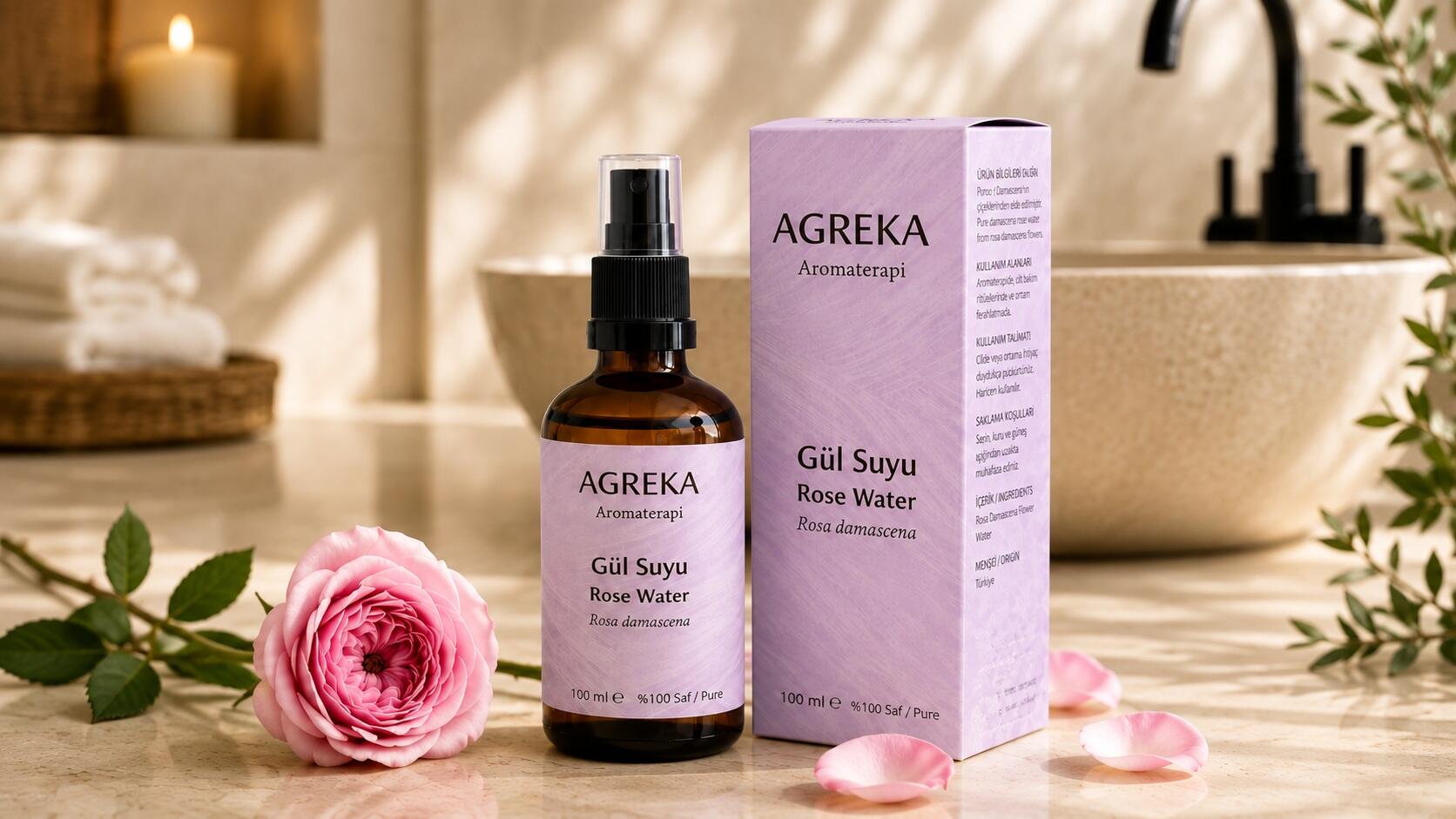
Benefits, Uses, and Scientific Evidence
Rose water is an aromatic hydrosol obtained during the steam distillation of rose petals. It is widely valued for its soothing effects on the skin, its ability to help balance skin tone, provide antioxidant protection, and support the care of sensitive skin.
Thanks to its naturally occurring phenolic compounds and the water-soluble fraction of rose essential oil, rose water has an important place in both traditional and modern dermocosmetic applications.
Rose Water – General Information
Botanical (Latin) Name:Rosa damascena
Plant Family: Rosaceae
Origin: Türkiye (Isparta), Bulgaria, Iran
Extraction Method: Steam distillation (hydrosol obtained during essential oil production)
Plant Part Used: Flower petals
Appearance: Colorless to slightly cloudy
Suitable Skin Types: Sensitive, dry, normal, mature, and reactive skin
Chemical Composition (Key Active Components)
Rose water contains the water-soluble aromatic and phenolic compounds of rose essential oil, including:
- Phenethyl alcohol
- Citronellol
- Geraniol
- Linalool
- Flavonoids
- Phenolic acids
These compounds are responsible for rose water’s antioxidant, soothing, and mild antimicrobial properties.
History and Traditional Use
There is strong evidence that the Rosaceae plant family has ancient origins. Thirty-million-year-old rose fossils have been discovered in North America. The earliest historical records found on Mesopotamian cuneiform tablets indicate that roses were known to humans approximately 5,000 years ago. Assyrian tablets also mention both roses and rose water. Although it is impossible to identify the exact rose species described in these ancient texts, their fragrance is consistently praised.
These cuneiform records also indicate that roses were not distilled directly; instead, they were boiled in water to obtain fragrant aromatic water.
The Damask rose originated in the Middle East. Some historical evidence suggests that rose water originated in Persia (modern-day Iran), while fragrant rose oils and extracts were first developed in Greece. Crude distillation of roses for essential oil production is believed to have begun toward the end of the 7th century CE and gradually spread to other regions by the 14th century.
The renowned physician Ibn Sina (Avicenna, 11th century CE) was among the first scholars to describe the beneficial effects of the fragrance of roses on the heart and brain. He wrote:
“It has a calming effect and is highly beneficial for the heartbeat. It improves understanding and strengthens memory. It sharpens the senses and enhances vitality.”
For centuries, roses inspired artists to create masterpieces and motivated kings and sultans to establish magnificent gardens celebrated for their beauty and fragrance. Today, roses are cultivated throughout the world, including Iran, Europe, Bulgaria, Türkiye, and India.
Members of the Rosaceae family are among the world’s best-known ornamental plants, and the rose is often referred to as the queen of flowers. Today, more than 200 rose species and over 18,000 cultivated varieties have been identified.
Rose water is the hydrosol produced during the steam distillation of rose petals for the extraction of rose essential oil. The first distillation rose water naturally contains a small amount of rose essential oil and therefore retains many of the beneficial aromatic compounds found in the essential oil itself.
Benefits of Rose Water
1. Soothes the Skin and Helps Reduce Redness
Rose water provides soothing support for sensitive, irritated, and reactive skin and may help reduce visible redness. [1] [2]
2. Antioxidant Protection
Its naturally occurring phenolic compounds help protect the skin against free radical damage through antioxidant activity. [1] [3] [4]
3. Helps Balance Skin Tone and pH
Because its natural pH is close to that of the skin, rose water can be used as a facial toner to help maintain the skin’s natural balance. [5]
4. Mild Antimicrobial Activity
Rose water has been reported to exhibit mild antimicrobial activity against certain Gram-positive bacteria. [6] [7]
5. Natural Astringent Properties
Its mild astringent properties may help minimize the appearance of pores. [8]
6. Emotional Well-Being Support
Rose water may help promote emotional balance, deepen emotional awareness, and encourage feelings of peace and well-being through its delicate floral aroma. During periods of sadness or grief, it may be inhaled for its uplifting fragrance or used as a room spray. [9]
Safety Information
Direct contact with the eyes is not recommended.
Scientific References
[1] A. Safia, Z. Aamir, A. Iqbal, S. Rafi, M. Zafar (2019). Assessment of Rose Water and Evaluation of Antioxidant and Anti-inflammatory Properties of a Rose Water Based Cream Formulation. International Journal of Pharmaceutical and Clinical Research 2019; 11(1): 43–48.
[2] M. H. Boskabady, M. N. Shafei, Z. Saberi, S. Amini (2011). Pharmacological Effects of Rosa damascena. Iran J Basic Med Sci. 2011 Jul-Aug;14(4):295–307.
[3] S. Abidi, N. Shaheen, I. Azher, Z. A. Mahmood (2018). Photoprotective and Antioxidant Activities along with Phytochemical Investigation of Rose Water. IJPSR. 2018;9(12):1000–1008.
[4] S. Shahriari, N. Yasa, A. Mohammadirad, R. Khorasani, M. Abdollahi (2007). In vivo Antioxidant Potentials of Rosa damascena Petal Extract from Guilan, Iran, Comparable to α-Tocopherol. International Journal of Pharmacology. 3:187–190.
[5] Lee, M. et al. Skin Anti-inflammatory Activity of Rose Petal Extract (Rosa gallica) Through Reduction of the MAPK Signaling Pathway. Food Science & Nutrition. 2018;6(8):2560–2567.
[6] Sharifzadeh, A., Fadaei, M., & Akbarzadeh, A. (2018). Antimicrobial and Cytotoxic Activity of Rosa damascena Mill. Essential Oil. Journal of Essential Oil Bearing Plants. 21(2):471–480.
[7] Sezer, C. V. et al. Cytotoxic and Antimicrobial Activities of Turkish Rose Oil and Its Major Metabolite S-(-)-Citronellol. Journal of Research in Pharmacy. 2024;28(4):899–911.
[8] Wos, K. et al. Rose Hydrolate (Rosa Flower Water) as an Ingredient in Cosmetics for Sensitive Skin. Archives of Physical and Global Research. 2021;25(1):53–67.
[9] Mohebitabar, S. et al. Therapeutic Efficacy of Rose Oil: A Comprehensive Review of Clinical Evidence. Avicenna Journal of Phytomedicine. 2017 May-Jun;7(3):206–213.

Patchouli Essential Oil (Pogostemon cablin)

Eucalyptus Essential Oil (Eucalyptus globulus)

Niaouli Essential Oil (Melaleuca quinquenervia)

Myrtle Leaf Essential Oil (Myrtus communis)

Lemon Essential Oil (Citrus limon)

