
Rice Bran Oil (Oryza sativa)
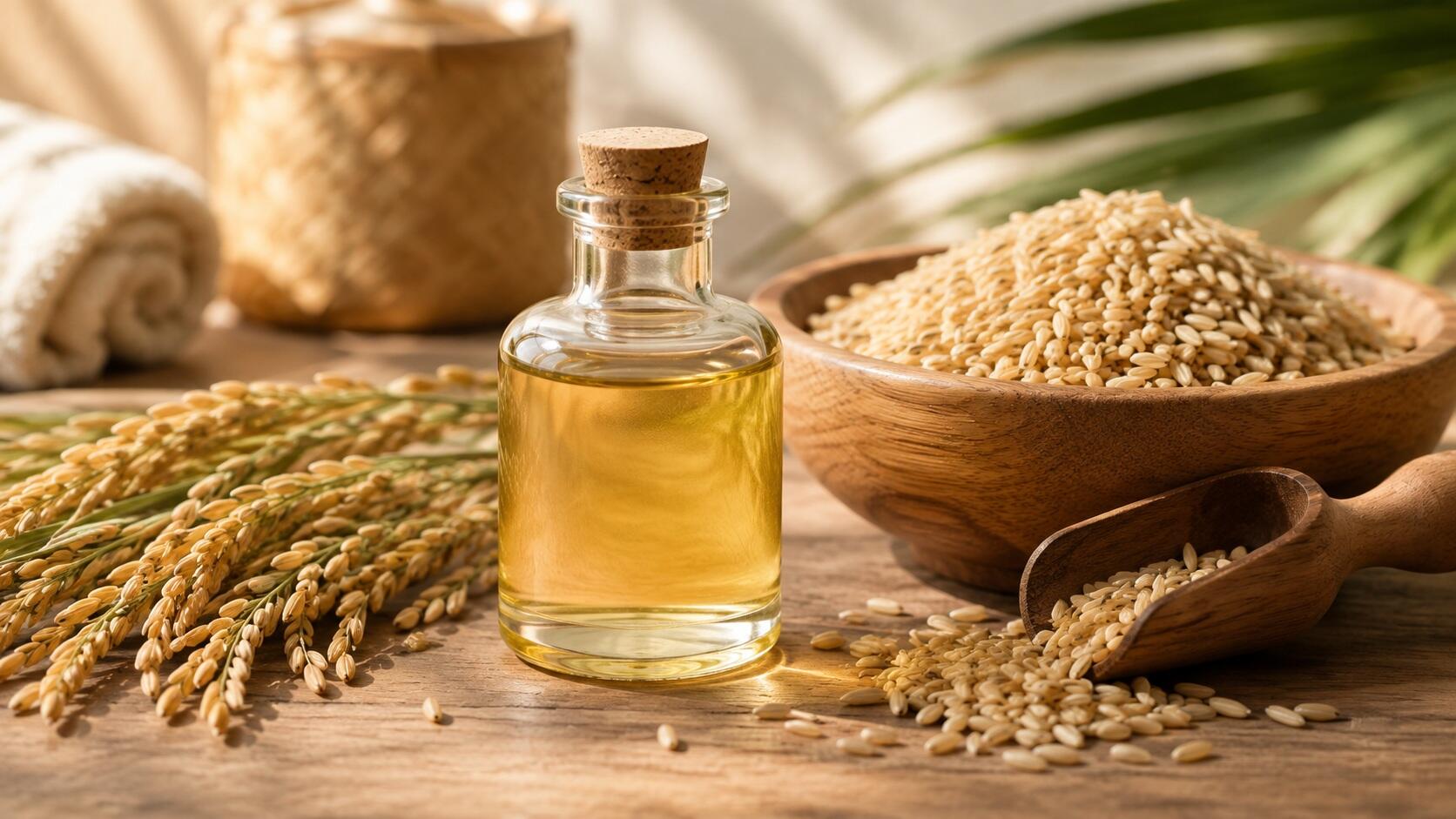
Benefits, Uses, and Scientific Evidence
Rice bran oil is a valuable carrier (fixed) oil widely used for antioxidant protection, improvement of uneven skin tone, skin brightening, skin barrier support, and mature skin care.
Its naturally high content of gamma-oryzanol, tocopherols, and phytosterols has made it an important subject of dermatological and cosmetic research.
Rice Bran Oil – General Information
Botanical (Latin) Name:Oryza sativa
Origin: Asia (Japan, China, India)
Extraction Method: Cold-pressed
Plant Part Used: Bran (the outer layer of the rice grain)
Color: Light yellow to golden
Texture: Light to medium-weight, silky
Comedogenic Rating: 2
Suitable Skin Types: Mature, hyperpigmented, normal to combination, and sensitive skin
Chemical Composition (Key Active Components)
The biological activity of rice bran oil is associated with its rich antioxidant profile, including:
- Gamma-oryzanol – the principal active constituent
- Linoleic acid (Omega-6)
- Oleic acid (Omega-9)
- Palmitic acid
- Phytosterols
- Tocopherols and tocotrienols (Vitamin E complex)
These constituents form the basis of the oil’s antioxidant, anti-inflammatory, and skin barrier-supporting properties.
History and Traditional Use
Rice bran oil (Oryza sativa) is extracted from the bran, the hard, brown, oil-rich layer located between the outer husk and the endosperm of the rice grain. This layer contains the highest concentration of nutrients and lipids within the grain.
Today, rice accounts for approximately one-fifth of global cereal production and is cultivated in more than 100 countries. Archaeological and genetic evidence suggests that rice was first domesticated approximately 9,000–10,000 years ago in China’s Yangtze River Valley. From there, rice cultivation spread throughout Japan, Southeast Asia, India, and Iran, eventually reaching the Mediterranean region and later the Americas during the 17th century. Today, Asia, Africa, and the Americas are the major rice-producing regions, with India, China, Japan, and Thailand among the leading producers.
Rice has long symbolized prosperity, fertility, and good fortune in many cultures. Traditions such as throwing rice over newlyweds reflect these symbolic meanings that continue to this day.
Rice bran oil holds a special place in Japanese and Korean beauty traditions. In Japan, komenuka (rice bran) has been used in skincare for centuries. Rice washing water and rice bran were traditionally believed to soften, brighten, and smooth the skin.
Today, rice bran oil is widely incorporated into anti-aging, skin tone-evening, and barrier-strengthening formulations. Its antioxidant compounds help protect the skin against free radical damage, while its fatty acid profile supports the skin’s natural lipid barrier.
Benefits of Rice Bran Oil
1. Antioxidant and Photoaging Protection
Thanks to its gamma-oryzanol and tocotrienol content, rice bran oil helps protect the skin against UV-induced oxidative stress and free radical damage. [1] [2]
It nourishes the skin without leaving a greasy feel, making it particularly suitable for combination and mature skin.
2. Support for Hyperpigmentation and Uneven Skin Tone
Its antioxidant compounds and ingredients that contribute to melanin regulation may provide supportive benefits for hyperpigmentation and sun spots. [3] [4]
3. Skin Barrier Support
Its linoleic and oleic acid content helps support the integrity of the skin’s lipid barrier while reducing transepidermal water loss (TEWL). [5]
4. Anti-Inflammatory Activity
The phytosterols and gamma-oryzanol found in rice bran oil contribute to the modulation of inflammatory responses. [6]
Safety Information
- Rice bran oil is generally well tolerated.
- Allergic reactions are rare.
Scientific References
[1] Rigo, L. A., et al. (2015). Nanoencapsulation of Rice Bran Oil Increases Its Protective Effects Against UVB Radiation-Induced Skin Damage in Mice. European Journal of Pharmaceutics and Biopharmaceutics.
[2] Badalkhani, O., et al. (2023). Nanogel Containing Gamma-Oryzanol-Loaded Nanostructured Lipid Carriers and TiO₂/MBBT: A Synergistic Nanotechnological Approach of Potent Natural Antioxidants and Nanosized UV Filters for Skin Protection. Pharmaceuticals (Basel). 2023 Apr 28;16(5):670.
[3] Jun, H., et al. (2012). Dual Inhibition of γ-Oryzanol on Cellular Melanogenesis: Inhibition of Tyrosinase Activity and Reduction of Melanogenic Gene Expression by a PKA-Dependent Mechanism. Journal of Natural Products. 75(10).
[4] Jufri, M., Vardhani, A., & Purwaningsih, E. (2021). Evaluating the Efficacy of Lotion Containing Black Rice Bran (Oryza sativa* L. indica) Extract as a Skin Brightening Agent: A Clinical Trial.* Jundishapur Journal of Natural Pharmaceutical Products, 16(4), e114152.
[5] Lin, T.-K., Zhong, L., & Santiago, J. L. (2018). Anti-Inflammatory and Skin Barrier Repair Effects of Topical Application of Some Plant Oils. International Journal of Molecular Sciences, 19(1), 70.
[6] Liu, Z., et al. (2023). Phytosterols in Rice Bran and Their Health Benefits. Frontiers in Nutrition. 2023 Oct 12;10:1287405.

Patchouli Essential Oil (Pogostemon cablin)

Eucalyptus Essential Oil (Eucalyptus globulus)

Niaouli Essential Oil (Melaleuca quinquenervia)

Myrtle Leaf Essential Oil (Myrtus communis)

Lemon Essential Oil (Citrus limon)

