
Pomegranate Seed Oil (Punica granatum)
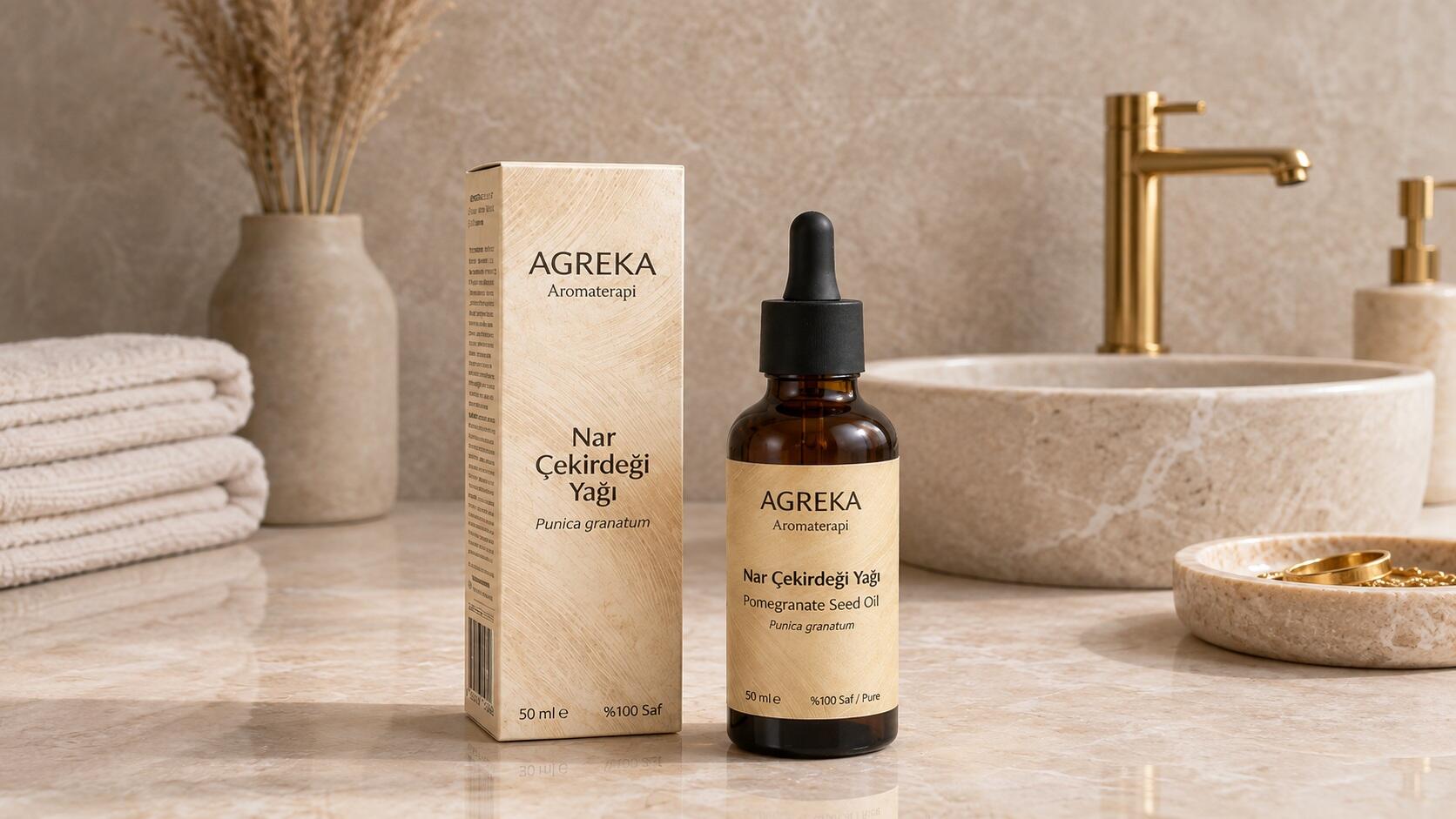
Benefits, Uses, and Scientific Evidence
Pomegranate seed oil is a powerful carrier (fixed) oil widely used to support anti-aging skincare, skin elasticity, skin barrier repair, antioxidant protection, and the modulation of inflammatory processes.
Unlike most vegetable oils, it is biochemically distinguished by its exceptionally high concentration of punicic acid (Omega-5, conjugated linolenic acid), making it a subject of growing interest in dermatological research.
Pomegranate Seed Oil – General Information
Botanical (Latin) Name:Punica granatum
Origin: Middle East, Mediterranean region, India, China
Extraction Method: Cold-pressed
Plant Part Used: Seeds
Color: Golden yellow to reddish
Texture: Medium-weight, nourishing
Comedogenic Rating: 1–2
Suitable Skin Types: Mature, dry, sensitive skin and skin experiencing loss of elasticity
Chemical Composition (Key Active Components)
The therapeutic properties of pomegranate seed oil are attributed to its high concentration of conjugated fatty acids and antioxidant compounds, including:
- Punicic acid (approximately 60–75%) – the principal active constituent
- Oleic acid (Omega-9)
- Linoleic acid (Omega-6)
- Phytosterols
- Polyphenols
- Tocopherols (Vitamin E)
These constituents provide the basis for the oil’s anti-inflammatory, antioxidant, and collagen-supporting properties.
History and Traditional Use
The pomegranate is believed to have originated in the region extending from present-day Iran to northern India. Archaeobotanical and historical evidence indicates that it has been cultivated throughout the Middle East, South Asia, and the Mediterranean Basin for several thousand years. Although it is considered one of the earliest domesticated fruit trees in the Eastern Mediterranean, reliable evidence suggests that it was certainly under cultivation by the third millennium BCE.
Pomegranates are mentioned in Mesopotamian cuneiform tablets dating from the mid-third millennium BCE. In Ancient Egypt, the fruit symbolized rebirth and fertility, and pomegranates as well as pomegranate-shaped objects have been discovered in tombs. Remains of pomegranates have been identified in the tombs of Hatshepsut (15th century BCE) and Amenhotep II, while the silver pomegranate-shaped vessel found in Tutankhamun’s tomb reflects its symbolic significance. Ancient Egyptians associated the fruit with prosperity and vitality.
In Anatolia, pomegranates are believed to have symbolized agricultural abundance within Hittite iconography. The discovery of pomegranate remains in the Uluburun Shipwreck (14th century BCE) demonstrates that the fruit was traded throughout Mediterranean commercial networks. The ancient city of Side, whose name is believed to mean “pomegranate” in Anatolian languages, further illustrates its cultural importance. The Greek historian Herodotus recorded that Persian soldiers decorated their spearheads with golden and silver pomegranates.
Through the Silk Road and maritime trade, the pomegranate spread to East Asia, where it was cultivated in southern China and Southeast Asia. In Korea and Japan, it was also appreciated as an ornamental bonsai species. During the late 16th century, Spanish colonists introduced the pomegranate to the Caribbean and the Americas.
Today, pomegranates are widely cultivated across the Middle East, the Caucasus, the Mediterranean Basin, North Africa, India, Central Asia, and many other semi-arid and subtropical regions around the world.
Benefits of Pomegranate Seed Oil
1. Anti-Aging and Collagen Support
Pomegranate seed oil helps support the appearance of fine lines, reduced skin elasticity, and skin sagging. Punicic acid has been reported to promote fibroblast activity, which is essential for collagen production. [1] [2]
2. Powerful Antioxidant Protection
Pomegranate seed oil helps protect the skin against free radical damage and UV-induced oxidative stress. [2] [3]
3. Skin Barrier Repair and Moisture Support
Its linoleic acid and phytosterol content helps support the integrity of the skin barrier while reducing transepidermal water loss (TEWL). [4] [5]
4. Support for Sensitive and Reactive Skin
Thanks to its polyphenol and tocopherol content, pomegranate seed oil may provide soothing support for skin prone to redness and sensitivity. [6] [7]
Safety Information
- Pomegranate seed oil is generally well tolerated.
- Because it is susceptible to oxidation, it should be stored in a cool, dark place.
- Due to its concentrated nature, it is commonly incorporated into formulations at concentrations between 5% and 20%.
Scientific References
[1] Li, Z. The Effect of Pomegranate on Aging and Inflammation of the Skin (PomSkin). ClinicalTrials.gov Identifier: NCT02258776.
[2] Afaq, F., & Mukhtar, H. (2006). Botanical Antioxidants in the Prevention of Photocarcinogenesis and Photoaging. Experimental Dermatology. 15:678–684.
[3] Baccarin, T., Mitjans, M., Ramos, D., Lemos-Senna, E., & Vinardell, M. P. (2015). Photoprotection by Pomegranate (Punica granatum) Seed Oil Nanoemulsion Entrapping Polyphenol-Rich Ethyl Acetate Fraction Against UVB-Induced DNA Damage in Human Keratinocyte (HaCaT) Cell Line. Journal of Photochemistry and Photobiology B: Biology.
[4] Wang, X., et al. (2024). The Role of Linoleic Acid in Skin and Hair Health: A Review. International Journal of Molecular Sciences. 2025;26(1):246.
[5] Lin, T.-K., Zhong, L., & Santiago, J. L. (2018). Anti-Inflammatory and Skin Barrier Repair Effects of Topical Application of Some Plant Oils. International Journal of Molecular Sciences. 19(1):70.
[6] Costa, E. M., Machado, M., Pintado, M., et al. (2025). Evaluating Pomegranate Seed Oil for Potential Topical Applications: Safety, Anti-Inflammatory Activity and Wound Healing in Skin Cell Models. Inflammopharmacology. 33(11):7045–7055.
[7] Kaseke, T., et al. (2021). Quality and Antioxidant Properties of Cold-Pressed Oil from Blanched and Microwave-Pretreated Pomegranate Seed. Foods. 10(4):712.

Patchouli Essential Oil (Pogostemon cablin)

Eucalyptus Essential Oil (Eucalyptus globulus)

Niaouli Essential Oil (Melaleuca quinquenervia)

Myrtle Leaf Essential Oil (Myrtus communis)

Lemon Essential Oil (Citrus limon)

