
Grapefruit Essential Oil (Citrus paradisi)
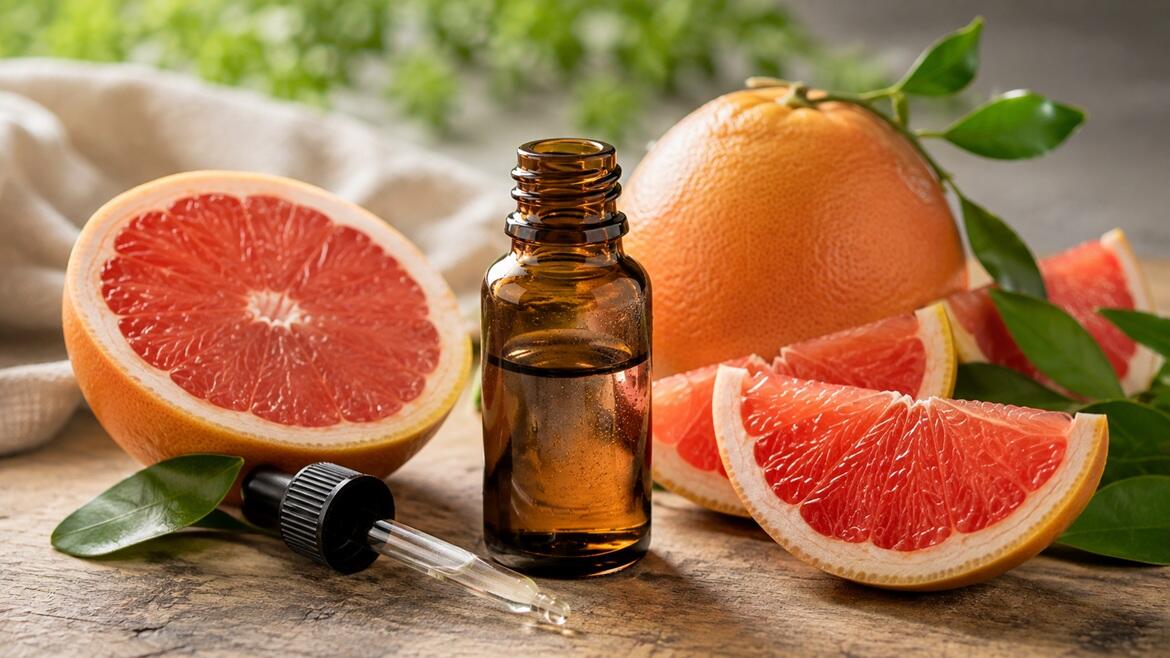
Benefits, Uses, and Scientific Evidence
Grapefruit essential oil is a powerful aromatherapy oil valued for its fresh, uplifting citrus aroma and its traditional use in supporting the lymphatic system, circulation, skin health, and emotional well-being. Traditional aromatherapy knowledge is largely supported by modern scientific research.
Grapefruit Essential Oil – General Information
Botanical (Latin) Name:Citrus paradisi
Plant Family: Rutaceae (Citrus Family)
Origin: Caribbean, United States, Mediterranean region, South Africa
Extraction Method: Cold pressing
Plant Part Used: Fruit peel
Color: Pale yellow to orange
Aroma Profile: Fresh, bright, sweet, citrus
Aromatic Note: Top note
Chemical Composition (Key Active Components)
The biological effects of grapefruit essential oil are primarily associated with its monoterpene hydrocarbons. The principal constituents commonly identified through GC/MS analysis include:
- d-Limonene (major constituent)
- β-Myrcene
- α-Pinene
- Sabinene
- Nootkatone
History and Traditional Use
Unlike many other citrus fruits, grapefruit (Citrus paradisi) was not known in ancient times. It first appeared in the Caribbean, particularly in Barbados, during the 18th century. Grapefruit is a natural hybrid of pomelo (Citrus maxima) and sweet orange (Citrus sinensis), and therefore does not appear in ancient medical texts alongside lemon, bergamot, or orange. It is considered a “modern citrus.”
The use of grapefruit essential oil is almost as recent as the fruit itself. During the 18th and 19th centuries, the essential oil began to be extracted from the peel by cold pressing.
Its bright, clean citrus aroma—less sharp than lemon and less sweet than orange—made it a popular ingredient in perfumes, soaps, cleaning products, and colognes.
From the 1950s onward, with the development of modern aromatherapy in England and France, grapefruit essential oil became widely used as an emotional and functional support oil to promote mental clarity, vitality, motivation, and a positive mood.
Benefits of Grapefruit Essential Oil
1. Skin Support
Grapefruit essential oil is traditionally used to support oily skin, cellulite, fluid retention (edema), and hair loss.
Its ability to support lymphatic circulation and improve skin firmness makes it a popular ingredient in cosmetic formulations and massage blends. [1] [2] [3]
2. Nervous System and Emotional Well-Being
Thanks to its uplifting aroma, grapefruit essential oil is used in aromatherapy to support emotional balance during periods of depression, anxiety, stress, and nervous fatigue. It is associated with enhanced mental clarity and motivation.
During emotional fluctuations related to agitation, irritability, and stress, grapefruit essential oil is valued for its balancing and calming aromatic effects.
It may also help relieve emotional sensitivity, tension, and stress associated with premenstrual syndrome (PMS). Synergistic blends with bergamot and lavender are particularly popular. [4] [5] [6]
3. Digestive System Support
Grapefruit essential oil is traditionally used in aromatherapy to support constipation, sluggish digestion, general digestive fatigue, and migraines associated with digestive disturbances.
It is particularly favored when digestive discomfort is linked to stress. [7]
4. Lymphatic System and Immune Support
In addition to its air-purifying properties, grapefruit essential oil is traditionally used in aromatherapy to support lymphatic circulation, reduce feelings of fluid retention, and promote the body’s natural detoxification processes. [8] [9] [10]
Safety Information
- Grapefruit essential oil should not be applied to the skin without proper dilution.
- Because it is cold-pressed, it may be phototoxic. Avoid direct sun exposure for at least 12 hours after topical application.
- A patch test is recommended for sensitive skin.
- Professional guidance should be sought before use during pregnancy or breastfeeding.
Scientific References
[1] Haze, S., et al. (2010). Grapefruit Oil Attenuates Adipogenesis in Cultured Subcutaneous Adipocytes. Planta Medica, 76(10), 950–955.
[2] Agarwal, P., et al. (2022). Citrus Essential Oils in Aromatherapy: Therapeutic Effects and Mechanisms. Antioxidants (Basel), 11(12), 2374.
[3] Ngamdokmai, N., Paracha, T. U., Waranuc, N., Chootip, K., Wisuitiprot, W., Suphrom, N., Insumrong, K., & Ingkaninan, K. (2021). Effects of Essential Oils and Some Constituents from Ingredients of Anti-Cellulite Herbal Compress on 3T3-L1 Adipocytes and Rat Aortae. Pharmaceuticals, 14, 253.
[4] Nagai, K., Niijima, A., Horii, Y., Shen, J., & Tanida, M. (2014). Olfactory Stimulation with Grapefruit and Lavender Oils Changes Autonomic Nerve Activity and Physiological Function. Autonomic Neuroscience, 185, 29–35.
[5] Aćimović, M., & Zeremski, T. (2025). Aromatherapy Application of Citrus Essential Oils: A Comprehensive Overview. Studies in Natural Products Chemistry, Volume 87, 191–237.
[6] Nagai, K., Niijima, A., Horii, Y., Shen, J., & Tanida, M. (2014). Olfactory Stimulation with Grapefruit and Lavender Oils Changes Autonomic Nerve Activity and Physiological Function. Autonomic Neuroscience, 185, 29–35.
[7] Tanida, M., Niijima, A., Shen, J., Nakamura, T., & Nagai, K. (2005). Olfactory Stimulation with the Scent of Grapefruit Essential Oil Affects Autonomic Neurotransmission and Blood Pressure. Brain Research, 1058(1–2), 44–55.
[8] Aydeniz-Guneser, B., & Guneser, O. (2020). Cold-Pressed Grapefruit (Citrus paradisi* L.) Oil.* In Cold Pressed Oils: Green Technology, Bioactive Compounds, Functionality, and Applications (pp. 497–513).
[9] Arinaga, Y., Sato, F., Piller, N., Kakamu, T., Kikuchi, K., Ohtake, T., Sakuyama, A., Yotsumoto, F., Hori, T., & Sato, N. (2016). A 10-Minute Self-Care Program May Reduce Breast Cancer-Related Lymphedema: A Six-Month Prospective Longitudinal Comparative Study. Lymphology, 49(2), 93–106.
[10] Ou, M.-C., Liu, Y.-H., Sun, Y.-W., & Chan, C.-F. (2015). The Composition, Antioxidant and Antibacterial Activities of Cold-Pressed and Distilled Essential Oils of Grapefruit (Citrus paradisi) and Related Citrus Species. Evidence-Based Complementary and Alternative Medicine, 2015, 804091.

Patchouli Essential Oil (Pogostemon cablin)

Eucalyptus Essential Oil (Eucalyptus globulus)

Niaouli Essential Oil (Melaleuca quinquenervia)

Myrtle Leaf Essential Oil (Myrtus communis)

Lemon Essential Oil (Citrus limon)

