Geranium Essential Oil (Pelargonium graveolens)
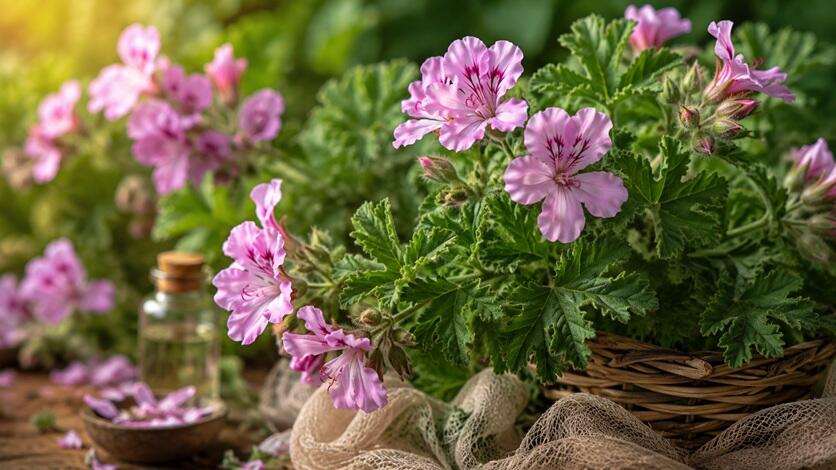
Geranium essential oil is a versatile essential oil with a sweet, floral, and slightly herbaceous aroma. In aromatherapy, it is widely used to support hormonal balance, skin health, emotional well-being, and healthy circulation. Its traditional uses are largely supported by modern pharmacological and physiological research.
Geranium Essential Oil General Information
Latin (Botanical) Name: Pelargonium graveolens
Plant Family: Geraniaceae
Origin: South Africa, Egypt, Morocco, Madagascar, Réunion Island, China
Extraction Method: Steam distillation
Plant Part Used: Flowering herb
Color: Pale yellow to greenish
Aroma Profile: Floral, sweet, green, slightly rose-like, fresh
Aromatic Note: Middle to middle-top note
Chemical Composition (Major Active Constituents)
The biological activities of geranium essential oil are mainly associated with its alcohols and monoterpenes. The principal constituents commonly identified by GC/MS analysis include:
- Citronellol
- Geraniol
- Linalool
- Citronellyl formate
- Geranyl formate
History and Traditional Use
Geranium (Pelargonium graveolens) is a plant native to South Africa.
Ancient Egyptians used geranium oil for a wide range of applications, including promoting clear, smooth, radiant skin, supporting hormonal balance, relieving anxiety and fatigue, and improving emotional well-being.
During the 17th and 18th centuries, it was introduced to Europe, where it became highly valued in French perfumery as one of the finest natural alternatives to rose oil.
In traditional herbal medicine, geranium was used to support menstrual balance, promote wound healing, and calm the nervous system.
In modern aromatherapy, geranium is often referred to as a “balancing oil” because it is believed to help support homeostasis in both physical and emotional systems.
Benefits of Geranium Essential Oil
1. Skin Support and Sebum Balance
Geranium essential oil is commonly used in aromatherapy to help support:
- Oily and acne-prone skin
- Enlarged pores
- Uneven skin tone
Scientific studies suggest that it may contribute to sebum regulation and help support the skin barrier. [1] [2] [3]
2. Hormonal Balance and PMS Support
Geranium essential oil is frequently preferred in aromatherapy during periods of premenstrual syndrome (PMS), menopause, and emotional fluctuations associated with hormonal changes. Its balancing effects on the endocrine system have been highlighted in the scientific literature. [4] [5]
3. Nervous System and Emotional Well-being
With its soft, sweet floral aroma, geranium essential oil is widely used to promote relaxation during periods of stress, anxiety, and emotional tension. Research has demonstrated regulatory effects on the autonomic nervous system. [4] [6] [7]
4. Antimicrobial and Protective Activity
Geranium essential oil has demonstrated antimicrobial activity against various bacterial and fungal species. Therefore, it is considered a valuable supportive ingredient in cosmetic and personal care formulations. [8] [9]
5. Anti-inflammatory Activity
Due to its anti-inflammatory properties, geranium essential oil may help support both the prevention and management of acute and chronic inflammatory skin conditions. It is also commonly used in massage oils to help relieve swelling associated with edema. [2] [10] [11]
Safety and Precautions
- It has GRAS (Generally Recognized As Safe) status.
- As an essential oil, it should never be applied to the skin without proper dilution.
- A patch test is recommended for individuals with sensitive skin.
- Consult a healthcare professional before use during pregnancy, breastfeeding, or when using with children.
Scientific References
[1] Kozlowska, J., Kaczmarkiewicz, A., Stachowiak, N., & Sionkowska, A. (2017). Evaluation of Sebostatic Activity of Juniperus communis Fruit Oil and Pelargonium graveolens Oil Compared to Niacinamide. Cosmetics, 4(3), 36.
[2] El-Otmani, N., el Ouazzani, F., Akoh, R., et al. (2024). Assessment of Pelargonium graveolens flower essential oil: Antimicrobial, antioxidant, enzyme inhibition and in vivo topical analgesic and anti-inflammatory efficacy as treatment for atopic dermatitis. F1000Research, 13:1366.
[3] Lohani, A., et al. (2021). Topical Delivery of Geranium/Calendula Essential Oil Entrapped Ethanolic Lipid Vesicular Cream to Combat Skin Aging. Biomed Res Int. 2021 Sep 11;2021:4593759.
[4] Fahimeh Rashidi Fakari, Mahbubeh Tabatabaeichehr, Hossian Kamali, Farzaneh Rashidi Fakari, Maryam Naseri. Effect of Inhalation of Aroma of Geranium Essence on Anxiety and Physiological Parameters during First Stage of Labor in Nulliparous Women: a Randomized Clinical Trial. J Caring Sci. 2015 Jun 1;4(2):135–141.
[5] Simões BM, Kohler B, Clarke RB, Stringer J, Novak-Frazer L, Young K, Rautemaa-Richardson R, Zucchini G, Armstrong A, Howell SJ. Estrogenicity of Essential Oils Is Not Required to Relieve Symptoms of Urogenital Atrophy in Breast Cancer Survivors. Therapeutic Advances in Medical Oncology. 2018;10:1758835918766189.
[6] F. R. Fakari, M. Tabatabaeichehr, H. Kamali, F. R. Fakari, M. Naseri (2015). Effect of Inhalation of Aroma of Geranium Essence on Anxiety and Physiological Parameters during First Stage of Labor in Nulliparous Women: a Randomized Clinical Trial. J Caring Sci. 2015 Jun;4(2):135–141.
[7] M. A. Tabari, A. H. Moghaddam, F. Maggi, G. Benelli (2018). Anxiolytic and Antidepressant Activities of Pelargonium roseum Essential Oil on Swiss Albino Mice: Possible Involvement of Serotonergic Transmission. Wiley Online Library, Volume 32, Issue 6, June 2018, Pages 1014-1022.
[8] Hsouna, A. B., & Hamdi, N. (2012). Phytochemical Composition and Antimicrobial Activities of the Essential Oils and Organic Extracts from Pelargonium graveolens Growing in Tunisia. Lipids in Health and Disease. 2012 Dec 5;11:167.
[9] Al-Mijalli, S. H., et al. (2022). Chemical Profiling and Biological Activities of Pelargonium graveolens Essential Oils at Different Developmental Stages. Plants. 2022, 11(17), 2226.
[10] M. N. Boukhatem, A. Kameli, M. A. Ferhat, F. Saidi, M. Mekarnia (2013). Rose Geranium Essential Oil as a Source of New and Safe Anti-inflammatory Drugs. Libyan Journal of Medicine. 2013;8:22520.
[11] El-Otmani, N., el Ouazzani, F., Akoh, R., et al. (2024). Assessment of Pelargonium graveolens Flower Essential Oil: Antimicrobial, Antioxidant, Enzyme Inhibition and In Vivo Topical Analgesic and Anti-inflammatory Efficacy as Treatment for Atopic Dermatitis. F1000Research. 2024, 13:1366. Last updated: 11 April 2025.

Patchouli Essential Oil (Pogostemon cablin)

Eucalyptus Essential Oil (Eucalyptus globulus)

Niaouli Essential Oil (Melaleuca quinquenervia)

Myrtle Leaf Essential Oil (Myrtus communis)

Lemon Essential Oil (Citrus limon)

