
Chamomile Water (Matricaria chamomilla)
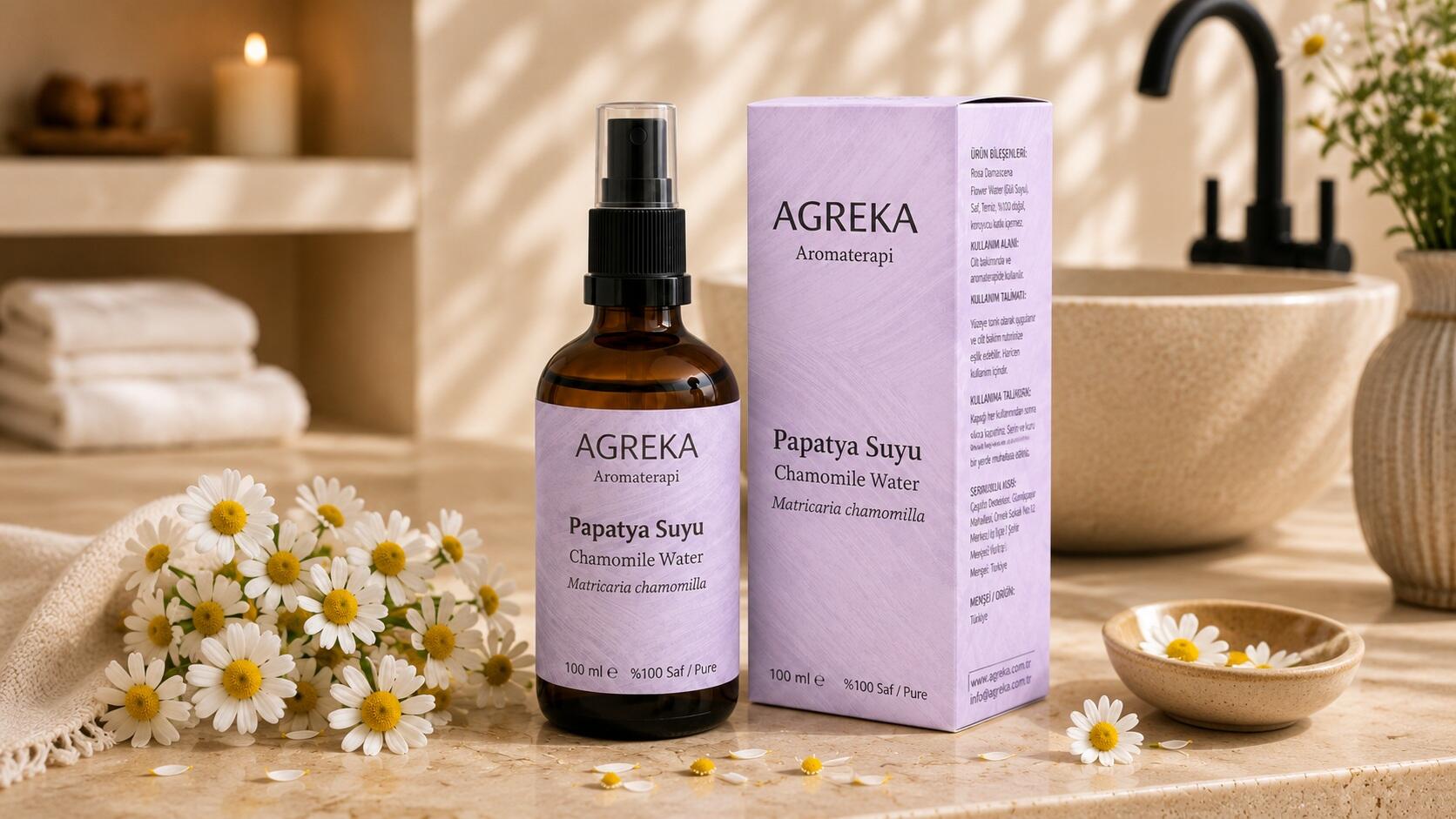
Benefits, Uses, and Scientific Evidence
Chamomile water (hydrolat/hydrosol) is an aromatic hydrosol obtained during the steam distillation of chamomile flowers. It is particularly valued for the care of sensitive skin, redness, atopic-prone skin, baby skincare, and soothing the delicate eye area.
Thanks to its naturally occurring flavonoids and azulene derivatives, chamomile hydrosol has gained recognition not only through traditional use but also in modern anti-inflammatory and dermatological research.
Chamomile Water – General Information
Botanical (Latin) Name:Matricaria chamomilla
Plant Family: Asteraceae (Daisy Family)
Origin: Europe, Türkiye, Germany, Egypt
Extraction Method: Steam distillation (hydrosol obtained during essential oil production)
Plant Part Used: Flower heads
Appearance: Colorless to pale yellow
Suitable Skin Types: Sensitive, atopic-prone, baby skin, and redness-prone skin
Chemical Composition (Key Active Components)
Chamomile water contains the water-soluble fractions of chamomile essential oil that are naturally carried into the hydrosol, including:
Bisabolol oxides
Chamazulene derivatives
Flavonoids (Apigenin)
Phenolic acids
These compounds form the basis of chamomile water’s anti-inflammatory, soothing, and mild antimicrobial properties.
History and Traditional Use
The history of chamomile dates back to ancient civilizations. Its name is derived from the Greek word “chamaimēlon”, meaning “ground apple,” a reference believed to describe both its low-growing habit and its pleasant apple-like aroma.
Ancient Greeks, Egyptians, and Romans used chamomile flowers to support wound healing and to relieve symptoms of the common cold. Classical medical texts frequently mention chamomile as a remedy for a wide variety of ailments, and historical records from nearly every ancient civilization document its medicinal use.
In Ancient Egypt, chamomile was regarded as a sacred plant associated with Ra, the sun god. It was highly respected among medicinal herbs, and members of the nobility incorporated it into their beauty rituals. Chamomile held such an important place in Egyptian society that depictions of the plant can still be found in hieroglyphs dating back more than 2,000 years.
Chamomile’s reputation as a healing plant continued long after the ancient world. During the Middle Ages, it became a popular remedy for conditions including asthma, colic, fever, inflammation, nausea, and various skin disorders. In medieval Europe, the Anglo-Saxon herbal manuscript Lacnunga listed chamomile as one of the Nine Sacred Herbs.
Chamomile water is produced as a by-product during the steam distillation of chamomile essential oil. It is significantly less concentrated than chamomile essential oil and therefore may be applied directly to the skin without dilution in a carrier oil. It also possesses a softer, lighter fragrance.
Benefits of Chamomile Water
1. Anti-Inflammatory and Redness-Reducing Properties
Chamomile water provides a cooling and soothing effect for redness, skin sensitivity, and skin prone to eczema. [1] [2] [3]
2. Support for Atopic-Prone and Baby Skin
Thanks to its gentle nature, chamomile water may be used as supportive care for baby skin and diaper rash. [4] [5]
3. Eye Area Care and Cold Compress Applications
When applied as a cold compress, chamomile water may help soothe the delicate eye area, particularly in cases of allergy-related discomfort. [6]
4. Antioxidant Protection
Its flavonoid content may help protect the skin against free radical damage through antioxidant activity. [7]
5. Emotional Well-Being Support
Chamomile water may help support relaxation of the autonomic nervous system, promote emotional calmness, and assist in reducing symptoms associated with stress. [8] [9]
Safety Information
Individuals with allergies to plants in the Asteraceae (Daisy) family should use chamomile water with caution.
Scientific References
[1] European Medicines Agency (EMA). (2015). Assessment Report on Matricaria recutita L., flos and Matricaria recutita L., aetheroleum.
[2] Ferreira, E. B., et al. (2015). Topical Effects of Chamomilla recutita in Skin Damage: A Literature Review. PharmacologyOnLine, 3, 18–30.
[3] Sah, A., et al. (2022). A Comprehensive Study of Therapeutic Applications of Chamomile. Pharmaceuticals (Basel). 2022;15(10):1284.
[4] Afshari, Z., Jabraeili, M., Asaddollahi, M., & Ghojazadeh, M. (2015). Comparison of the Effects of Chamomile and Calendula Ointments on the Severity of Diaper Rash: A Double-Blind Randomized Controlled Trial. Evidence Based Care Journal.
[5] Ghanipour Badelbuu, S., Javadzadeh, Y., Jabraeili, M., Heidari, S., Etebar Matanag, N., & Arshadi, M. (2019). Effects of Aloe vera Gel versus Chamomile Ointment on the Extent of Diaper Dermatitis in Children: A Double-Blind Randomized Controlled Trial. Journal of Pediatric Perspectives, 7(5), 9461–9469.
[6] Cosmetic Ingredient Review (CIR). (2016). Safety Assessment of Chamomilla recutita-Derived Ingredients as Used in Cosmetics.
[7] Sotiropoulou, N. S., Megremi, S. F., & Tarantilis, P. (2020). Evaluation of Antioxidant Activity, Toxicity, and Phenolic Profile of Aqueous Extracts of Chamomile (Matricaria chamomilla L.) and Sage (Salvia officinalis L.) Prepared at Different Temperatures. Applied Sciences, 10, 2270.
[8] Amsterdam, J. D., Li, Y., Soeller, I., Rockwell, K., Mao, J. J., & Shults, J. (2009). A Randomized, Double-Blind, Placebo-Controlled Trial of Oral Matricaria recutita (Chamomile) Extract Therapy for Generalized Anxiety Disorder. Journal of Clinical Psychopharmacology, 29(4), 378–382.
[9] Mao, J. J., Xie, S. X., Keefe, J. R., et al. (2016). Long-Term Chamomile (Matricaria chamomilla L.) Treatment for Generalized Anxiety Disorder: A Randomized Clinical Trial. Phytomedicine, 23(14).

Patchouli Essential Oil (Pogostemon cablin)

Eucalyptus Essential Oil (Eucalyptus globulus)

Niaouli Essential Oil (Melaleuca quinquenervia)

Myrtle Leaf Essential Oil (Myrtus communis)

Lemon Essential Oil (Citrus limon)

