
Calendula Oil (Calendula officinalis)
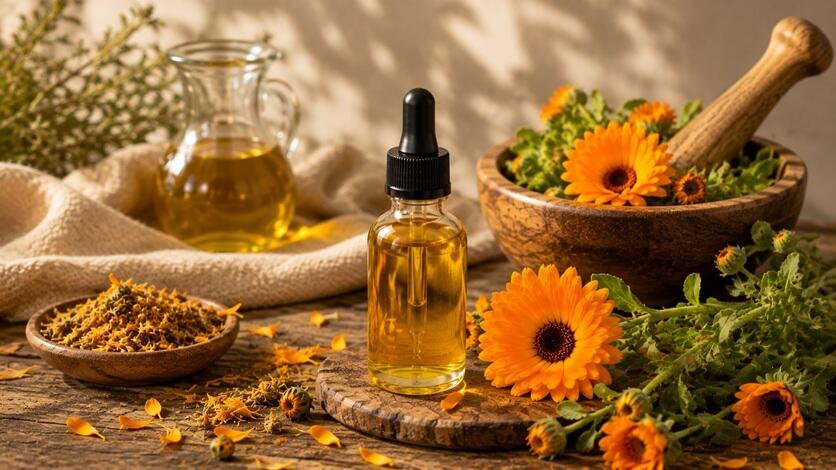
Benefits, Uses, and Scientific Evidence
Calendula oil is one of the most valuable herbal infused (macerated) oils, particularly appreciated for the care of sensitive skin, baby skin, atopic-prone skin, redness, impaired skin barrier function, and wound healing support.
The anti-inflammatory and skin-regenerating properties of Calendula officinalis flowers are well supported by modern dermatological and pharmacological research.
Calendula Oil – General Information
Botanical (Latin) Name:Calendula officinalis
Origin: Mediterranean region, Europe
Extraction Method: Maceration (typically infused in olive oil)
Plant Part Used: Flowers
Color: Golden yellow to orange
Texture: Medium-weight, soft
Comedogenic Rating: 1–2 (may vary depending on the carrier oil used for maceration)
Suitable Skin Types: Sensitive, dry, atopic-prone, baby, and mature skin
Chemical Composition (Key Active Components)
The therapeutic properties of calendula infused oil are derived from the bioactive compounds naturally present in the flowers, including:
- Linoleic acid (Omega-6)
- Palmitic acid
- Oleic acid (Omega-9)
- Stearic acid
- Triterpenoids (Faradiol esters)
- Flavonoids (Quercetin derivatives)
- Carotenoids (Lutein and beta-carotene)
- Saponins
- Phytosterols
These constituents form the basis of calendula oil’s anti-inflammatory, skin-regenerating, and soothing properties.
History and Traditional Use
Calendula (Calendula officinalis) is a medicinal plant native to the Mediterranean region and has been used for both medicinal and cosmetic purposes for centuries.
During the civilizations of Ancient Greece and Rome, calendula flowers were traditionally applied to cleanse wounds and soothe irritated skin. Roman physicians commonly recommended topical applications of calendula for minor cuts and abrasions.
Because of its bright orange-yellow blossoms, calendula became known throughout medieval Europe as the “Sun Herb,” symbolizing vitality and renewal. It was one of the principal medicinal plants cultivated in monastery gardens, where it was widely prepared as ointments and tinctures for skin care.
In Ayurveda and traditional European herbal medicine, calendula has long been regarded as one of the principal herbs for supporting skin integrity and reducing inflammation. Fresh crushed flowers or calendula flowers infused in oil were traditionally applied to wounds, cuts, minor burns, cracked and dry skin, and diaper rash in infants.
During the 19th century, physicians practicing American Eclectic Medicine frequently prescribed calendula preparations to support skin tissue repair. Today, modern phytotherapy recognizes calendula for its triterpenoids, flavonoids, and carotenoids, which contribute to its skin barrier-supporting and soothing properties.
Today, calendula oil is most commonly produced by macerating calendula flowers in olive oil or another carrier oil. It is especially valued in skincare products formulated for sensitive, dry, barrier-impaired, and atopic-prone skin.
Benefits of Calendula Oil
1. Anti-Inflammatory and Soothing Properties
Calendula oil provides soothing support for redness, eczema-prone skin, and dermatitis while helping reduce inflammatory responses. The anti-inflammatory effects of faradiol esters have been demonstrated in clinical studies. [1] [2]
2. Wound Healing and Skin Regeneration
Calendula oil is traditionally used to support tissue regeneration in minor cuts, superficial burns, and skin cracks. Studies have shown that it may promote collagen production and accelerate epithelial regeneration. [3] [4]
3. Support for Baby and Sensitive Skin
Thanks to its exceptionally gentle nature, calendula oil provides supportive care for diaper rash, weakened skin barrier function, and atopic-prone skin. [5] [6]
4. Antioxidant Protection
Its carotenoid and flavonoid content helps protect the skin against free radical damage through antioxidant activity. [7] [8]
5. Skin Barrier Support
When applied in a carrier oil formulation, calendula oil may help reduce transepidermal water loss (TEWL) while supporting the skin’s natural barrier function. [9] [10]
Safety Information
- Calendula oil is generally very well tolerated.
- Individuals with allergies to plants in the Asteraceae (Daisy) family should use it with caution.
Scientific References
[1] Golubova, D., et al. (2025). Biosynthesis and Bioactivity of Anti-Inflammatory Triterpenoids in Pot Marigold. Nature Communications.
[2] Silva, D., et al. (2021). Anti-Inflammatory Activity of Calendula officinalis L. Flower Extract. Cosmetics. 8(2):31.
[3] European Medicines Agency (EMA). (2018). Assessment Report on Calendula officinalis L., flos.
[4] Zitterl-Eglseer, K., et al. (1997). Anti-oedematous Activities of the Main Triterpendiol Esters of Calendula officinalis. Journal of Ethnopharmacology. 57(2):139–144.
[5] Panahi, Y., Sharif, M. R., Sharif, A., Beiraghdar, F., Zahiri, Z., & Amirchoopani, G. (2012). A Randomized Comparative Trial on the Therapeutic Efficacy of Topical Aloe vera and Calendula officinalis on Diaper Dermatitis in Children. The Scientific World Journal. 2012:810234.
[6] Mahmoudi, M., et al. (2015). Comparing the Effects of Bentonite and Calendula officinalis on Infantile Diaper Dermatitis: A Double-Blind Randomized Controlled Trial. Indian Journal of Medical Research. 142(6):742–746.
[7] Preethi, K. C., Kuttan, G., & Kuttan, R. (2006). Antioxidant Potential of an Extract of Calendula officinalis Flowers In Vitro and In Vivo. Pharmaceutical Biology.
[8] Ak, G., et al. (2020). A Comparative Bio-Evaluation and Chemical Profiles of Calendula officinalis L. Extracts Prepared via Different Extraction Techniques. Applied Sciences. 10(17):5920.
[9] Akhtar, N., et al. (2011). Evaluation of Various Functional Skin Parameters Using a Topical Cream of Calendula officinalis Extract. African Journal of Pharmacy and Pharmacology.
[10] Kodiyan, J., & Amber, K. T. (2015). A Review of the Use of Topical Calendula in the Prevention and Treatment of Radiotherapy-Induced Skin Reactions. Antioxidants. 4(2):293–303.

Patchouli Essential Oil (Pogostemon cablin)

Eucalyptus Essential Oil (Eucalyptus globulus)

Niaouli Essential Oil (Melaleuca quinquenervia)

Myrtle Leaf Essential Oil (Myrtus communis)

Lemon Essential Oil (Citrus limon)

