
Argan Oil (Argania spinosa)
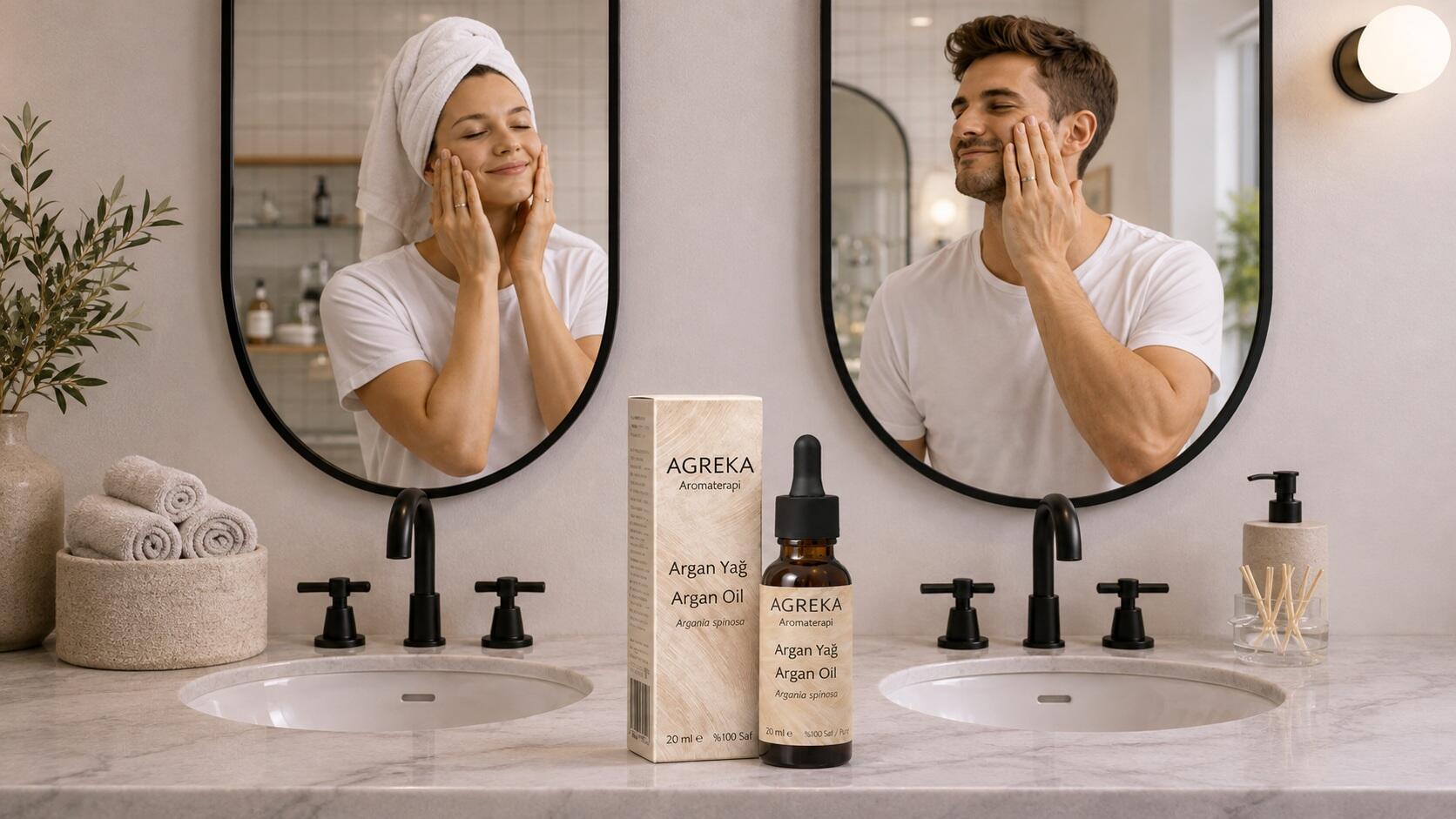
Benefits, Uses, and Scientific Evidence
Argan oil is a highly valued carrier (fixed) oil widely used for anti-aging skincare, improving skin elasticity, hair repair, strengthening the skin barrier, and providing antioxidant protection.
Native to Morocco, argan oil has become an important subject of dermatological research due to its high content of oleic acid, linoleic acid, tocopherols, and phytosterols.
Argan Oil – General Information
Botanical (Latin) Name:Argania spinosa
Origin: Morocco (particularly the Souss-Massa region)
Extraction Method: Cold-pressed
Plant Part Used: Kernel
Color: Golden yellow
Texture: Light to medium-weight, fast-absorbing
Comedogenic Rating: 0–1
Suitable Skin Types: Mature, dry, normal, sensitive skin; suitable for hair care
Chemical Composition (Key Active Components)
The biological activity of argan oil is attributed to its rich fatty acid profile and antioxidant content, including:
- Oleic acid (Omega-9, approximately 43–49%)
- Linoleic acid (Omega-6, approximately 29–36%)
- Palmitic acid
- Tocopherols (particularly gamma-tocopherol)
- Phytosterols (Schottenol and Spinasterol)
- Squalane
- Polyphenols
These constituents are responsible for argan oil’s antioxidant, skin barrier-supporting, and anti-aging properties.
History and Traditional Use
In the Berber region of southwestern Morocco, the Argania spinosa tree—commonly known as the Argan Tree—is also referred to as the “Tree of Life.” It is believed that the name originated from the village of Argana. The tree is renowned for the precious oil extracted from the kernels of its fruit, often called “Liquid Gold.”
Historically, argan oil was used by the indigenous Amazigh (Berber) people of Morocco to reduce the appearance of skin blemishes and to help relieve rheumatic conditions. Today, argan oil continues to be a highly valued ingredient in numerous natural cosmetic and pharmaceutical products.
As early as 1550 BCE, the Phoenicians reportedly used argan oil as a skin and hair conditioner and for both beauty and medicinal purposes.
The African explorer Leo Africanus documented argan oil during his travels through Morocco in 1510. In later centuries, this rare and exotic oil was introduced to Europe, where it remained an exclusive luxury available only to the wealthy. The legendary beauty of Berber women continues to be associated with the traditional use of argan oil.
Over the past several decades, scientists have investigated argan oil extensively and confirmed that it is rich in antioxidants and other bioactive compounds that contribute to healthier, more youthful-looking skin as well as healthy hair and nails.
Known for its ability to improve the appearance of youthful skin, argan oil has become one of the world’s most popular natural cosmetic ingredients, particularly among consumers seeking plant-based alternatives to synthetic chemicals.
Benefits of Argan Oil
1. Anti-Aging and Skin Elasticity Support
Argan oil helps support skin experiencing fine lines, loss of elasticity, and photoaging. Its tocopherol and polyphenol content provides powerful antioxidant protection. [1] [2]
2. Strengthens the Skin Barrier
Its oleic and linoleic acid content helps support the skin’s lipid barrier and may reduce transepidermal water loss (TEWL). [3] [4]
3. Antioxidant and Anti-Inflammatory Activity
Gamma-tocopherol and phytosterols contribute to the modulation of inflammation and protection against oxidative stress. [5] [6]
4. Hair Repair and Shine
Argan oil nourishes and softens dry, damaged, brittle, and frizzy hair, helping improve smoothness and shine. [7] [8]
5. Support for Sensitive and Reactive Skin
Its phytosterol content may help soothe sensitive skin and skin prone to redness. [9]
Safety Information
- Avoid direct contact with the eyes. If contact occurs, rinse thoroughly with plenty of water.
- Do not use if you have a known allergy to any of the product’s ingredients.
- A patch test on a small area of skin is recommended before first use.
Scientific References
[1] Boucetta, K. Q., et al. (2014). Skin Hydration in Postmenopausal Women: Argan Oil Benefit with Oral and/or Topical Use. Prz Menopauzalny. 13(5):280–288.
[2] Boucetta, K. Q., Charrouf, Z., Aguenaou, H., Derouiche, A., & Bensouda, Y. (2015). The Effect of Dietary and/or Cosmetic Argan Oil on Postmenopausal Skin Elasticity. Clinical Interventions in Aging. 10:339–349.
[3] Lin, T.-K., Zhong, L., & Santiago, J. L. (2018). Anti-Inflammatory and Skin Barrier Repair Effects of Topical Application of Some Plant Oils. International Journal of Molecular Sciences. 19(1):70.
[4] Manca, M. L., Matricardi, P., Cencetti, C., Peris, J. E., Melis, V., Carbone, C., Escribano, E., Zaru, M., Fadda, A. M., & Manconi, M. (2016). Combination of Argan Oil and Phospholipids for the Development of an Effective Liposome-like Formulation Able to Improve Skin Hydration and Allantoin Dermal Delivery. International Journal of Pharmaceutics. 505:204–211.
[5] Rabbaa, S., et al. (2025). Argan Oil: A Natural Bioactive Lipid Modulating Oxidative Stress and Inflammation. Antioxidants (Basel). 2025;14(5):515.
[6] Marfil, R., et al. (2011). Determination of Polyphenols, Tocopherols, and Antioxidant Capacity in Virgin Argan Oil (Argania spinosa Skeels). Lipid Science. 113(7):886–893.
[7] Sharifi, N., et al. (2022). Argan Oil as a Pretreatment of Human Hair Before Exposure to Oxidative Damage. Journal of Cosmetic Dermatology. 21(10):5010–5017.
[8] Faria, P. M., et al. (2013). Hair Protective Effect of Argan Oil (Argania spinosa Kernel Oil) and Cupuaçu Butter (Theobroma grandiflorum Seed Butter) Post Treatment with Hair Dye. Journal of Cosmetics, Dermatological Sciences and Applications. 3:40–44.
[9] Lin, T.-K., Zhong, L., & Santiago, J. L. (2018). Anti-Inflammatory and Skin Barrier Repair Effects of Topical Application of Some Plant Oils. International Journal of Molecular Sciences. 19(1):70.

Patchouli Essential Oil (Pogostemon cablin)

Eucalyptus Essential Oil (Eucalyptus globulus)

Niaouli Essential Oil (Melaleuca quinquenervia)

Myrtle Leaf Essential Oil (Myrtus communis)

Lemon Essential Oil (Citrus limon)

